
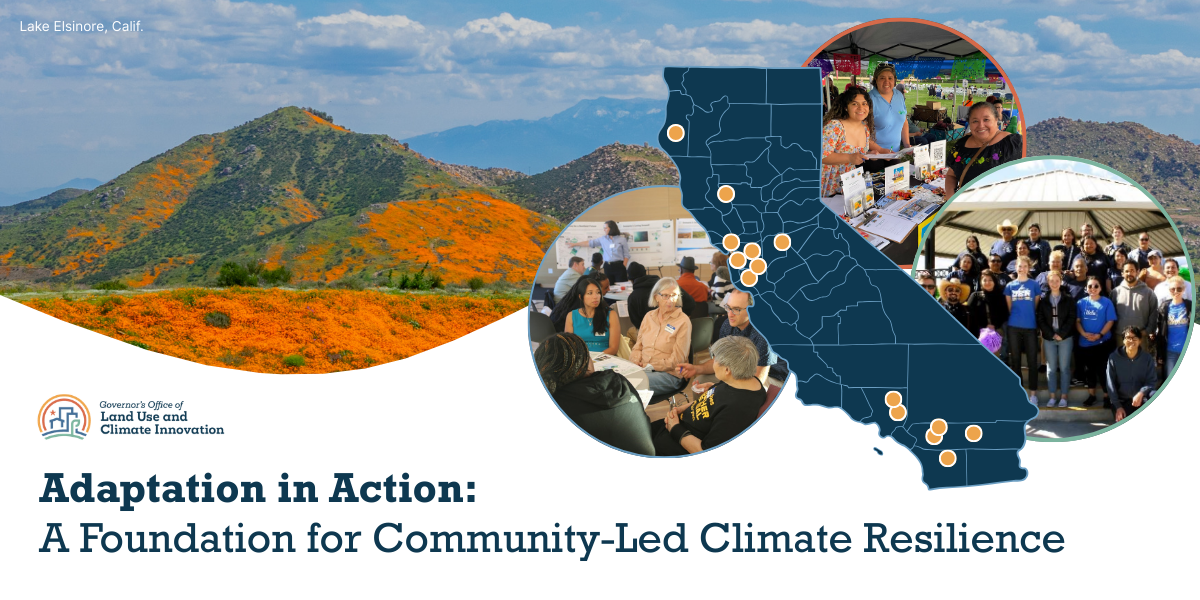
As California grapples with the accelerating effects of climate change, many communities are faced with planning for and responding to cascading and compounding impacts, including flooding and landslides following wildfires, or riverine flooding and sea level rise. The Adaptation Planning Grant Program (APGP), administered through the Integrated Climate Adaptation and Resiliency Program (ICARP), emerged from the 2021-22 climate budget as the state’s first planning grant program that supports an ‘all-risk’ approach to climate resilience. by approving funding for communities to plan for and respond to multiple climate hazards across sectors. APGP aims to fill local, regional, and Tribal planning needs by supporting communities across the state to identify climate resilience priorities, build capacity, and develop sustainable and resilient infrastructure projects. APGP provides flexible funding to meet multi-sector and multi-hazard planning needs, including but not limited to land use, transportation, housing, natural resource management, public infrastructure, and hazard mitigation.
Round 1 of the APGP invested $8 million across 14 climate adaptation planning projects led by partnerships made up of local, regional, Tribal governments, nonprofits, and academic institutions. APGP supports projects that prioritize vulnerable communities and address the greatest climate risks. APGP allows communities to fill multiple local and state planning requirements, while simultaneously encouraging applicants to plan for implementation funding, such as federal, philanthropic, and other state grant programs. APGP funding has served as a powerful catalyst for communities across the state, bridging critical planning gaps, building strategic partnerships, developing solutions, and laying the groundwork for implementation projects.
What They’re Saying
“APGP was a catalyst for us to pursue thinking about ways in which we could create or strengthen the pipeline of early conceptual ideas for climate-resilient infrastructure projects in the county that were multi-benefit, community-supported, and even community-led in some cases. Before APGP, we didn’t really have a good way to create that pipeline of projects.”
“Without APGP funding, many cities would have deficits, and they wouldn’t have an avenue to even work on Climate Action Plans. And because many cities don’t have allocated general funds for sustainability, these grants are essential to helping cities think about climate change and positive programs— [they] are so critical to being able to implement these programs.”
While APGP’s funding was limited to one round, its impacts will be longstanding, underscoring the need for long-term sustainable funding solutions for climate adaptation planning.
APGP Round 1 concluded in January 2026, resulting in 14 new or updated Climate Adaptation and Resilience Plans and strategies, and four new or updated General Plan Elements to address the impacts of climate change. Through meaningful and intentional partnerships with community-based organizations (CBOs), California Native American Tribes, and academic institutions, APGP grantees developed and implemented robust community engagement strategies, ensuring that every plan and strategy reflected the needs and priorities of those most impacted by climate hazards.
The seeds of APGP have been planted across the state, and if future funding becomes available, APGP’s framework and proven impact mean it is ready to return—with stronger tools, deeper community relationships, and a tested model that can be scaled statewide. APGP showed what’s possible; now it remains a roadmap for what comes next.
For example:
- Funded the first Climate Adaptation and Resilience Plans for 4 communities, including the Hoopa Valley Tribe, Lake County, and the Ramona Municipal Water District, in partnership with the Barona Band of Mission Indians, and the City of San Fernando.
- APGP grantees conducted outreach and engagement to 18,837 community members at 620 events in eight different languages, directly compensating more than 396 community members for their participation.
By prioritizing vulnerable communities, APGP grantees turned planning into action. It was the inaugural ICARP program that laid the foundation for other successful iterations—such as Regional Resilience pilots and the Extreme Heat Grant Program—which continue to expand community-led climate resilience across the state.
“APGP showed us what is possible when communities are resourced to lead climate resilience planning,” said Abby Edwards, Senior Deputy Director of the Governor’s Office of Land Use and Climate Innovation. “The result wasn’t just plans but it was stronger partnerships, deeper community engagement, and strategies rooted in the realities people face every day. The impact of this program will continue to share how California supports community-driven adaptation moving forward.”
Today, as California continues to strengthen its climate resilience investments, APGP’s influence endures—in the local leaders it supported, the partnerships it planted, and the resilient community strategies now guiding long-term state efforts.
APGP proved that real climate resilience starts with community leadership—turning planning into Adaptation in Action.
Full APGP Grantee List
Invested $8 million across 14 community-led planning efforts statewide.
Region: Northern California / North Coast & Mountains
- Hoopa Valley Tribe (Humboldt County) – ~$338,448
Develops a Tribal Adaptation Plan focused on wildfire, watershed health, salmon habitat, and cultural resources. - Lake County – “Planning for an Equitable, Climate-Safe Lake” – ~$649,350
Builds an inclusive climate-risk framework and equity-focused resilience planning across county operations.
Region: Bay Area
- City of Berkeley – ~$497,042
Updates its General Plan Safety and Environmental Justice elements, building resilience and equity metrics. - San Mateo County – “OneWatershed Climate Resilience Framework” – ~$649,648
Creates a watershed-based adaptation framework with regional agencies and community partners. - City of San Rafael (Marin County) – ~$644,200
Leads neighborhood-centered adaptation planning focused on the vulnerable Canal community. - Yosemite Slough – Bayview Hunters Point (San Francisco) – ~$649,000
Builds community-driven climate adaptation capacity and positions the area for future federal funding.
Region: Southern California – Los Angeles & Inland SoCal
- City of San Fernando (Los Angeles County) – ~$599,918
Creates a Climate Action and Resilience Plan with strong community engagement and land-use changes. - Los Angeles County – “LA’s Cool Capital Stack” – ~$556,000
Develops community-led infrastructure pipelines in heat-vulnerable neighborhoods. - City of Lake Elsinore (Riverside County) – ~$401,100
Develops a local climate adaptation plan focused on high-risk residents, heat, and storm impacts. - Ramona Municipal Water District & Barona Band of Mission Indians (San Diego County) – ~$596,600
Creates a joint Tribal–local adaptation plan addressing flooding, wildfire, landslides, and water supply. - Western Riverside Council of Governments (WRCOG) – ~$471,000
Studies microgrids for up to 10 future resilience hubs in vulnerable communities.
Region: San Joaquin Valley / Inland California
- City of Stockton (San Joaquin County) – ~$650,000
Builds a Climate Action and Adaptation Plan with community nonprofits, prioritizing pollution and health impacts.
Region: Eastern Coachella Valley / Desert Region
- Shade Equity Master Plan — Unincorporated Eastern Coachella Valley – ~$644,411
Designs shade infrastructure and cooling solutions in low-income communities facing extreme heat.
Region: Silicon Valley / South Bay
- City of San José – ~$649,970
Develops an adaptation strategy focused on critical infrastructure, water, energy resilience, and electrified transportation.
About the Integrated Climate Adaptation and Resiliency Program (ICARP)
ICARP (PRC 71350-71360) drives California’s response to climate impacts, prioritizing equitable approaches that integrate mitigation and adaptation. ICARP is housed within the Governor’s Office of Land Use & Climate Innovation and enables the state to coordinate across local, regional, and state efforts to support cohesive strategies.
Key Program Numbers & Timeline
- Program launches after being authorized in the FY 2021-22 State Budget via Senate Bill 170.
- APGP is administered under the Integrated Climate Adaptation and Resiliency Program (ICARP) by the Governor’s Office of Planning & Research (OPR) now Governor’s Office of Land Use & Climate Innovation (LCI).
- Total funding committed is $8 million across one round.
- The Round 1 grantee list includes diverse entities: cities, counties, Tribes, community-based organizations, etc., spanning many geographies.
- Grants ranged roughly from ~$338k to ~$650k per project, showing variability tied to project scope.