
By Kalin Kipling-Mojaddedi, LCI Communications
As international leaders – including California Governor Gavin Newsom – convene at Climate Week NYC, the impacts of extreme heat are top of mind.
Extreme heat is among the deadliest climate hazards on the planet, and the number of people exposed to extreme heat is growing exponentially worldwide due to climate change. In California and globally, heat waves are becoming more frequent, more intense, and longer lasting, leading to deadly consequences, devastating economic losses, and deteriorating infrastructure. And the impacts are hitting the world’s most vulnerable populations hardest.
That’s why California continues to take bold steps to build climate resilience in our state, and linking arms with countries, cities, and communities worldwide to present a united front against climate change-driven heat.
At a moment of increasing global instability, California will continue building strong relationships with partners around the globe to build a cleaner, more prosperous, more secure future.
International Partnerships to Build Resilience
Because extreme heat doesn’t respect boundaries, California has become a worldwide leader, forging alliances across the globe to exchange ideas on best practices for combating extreme heat.
Just as California is planning for a hotter future, other countries have also been leading on low-cost, community-based heat solutions for years and continue to innovate.
As extreme heat intensifies, we must continue to engage our international partners to share solutions, build on ideas and collective accomplishments, and accelerate action on extreme heat.
California has built partnerships with jurisdictions around the world, creating opportunities not only to share what we are learning, but to learn from others who are on the front lines of climate adaptation. We want to move beyond simply exchanging ideas. We want to build a stronger shared understanding of what works, how communities are organizing around heat, how governments are using data and science to make decisions, how investments are reaching people on the ground, and how we can accelerate implementation.
International collaboration has been a focus of the Newsom administration. Our state has partnered with jurisdictions in 27 countries, encompassing a fourth of the world’s population and a combined gross domestic product in the tens of trillions of dollars.
This week, Climate Week NYC offered a space for California leaders and innovators to connect, collaborate and build relationships with our international partners in the climate space.
During the week, Governor Newsom met with Spanish President Pedro Sánchez and Third Deputy Prime Minister and Minister for Ecological Transition and Demographic Challenge Sara Aagesen to sign a new Memorandum of Understanding strengthening California-Spain collaboration on climate action and clean energy. The MOU advances cooperation on clean energy and electrification, climate resilience and adaptation, carbon markets, methane reductions, the circular economy, and resilient buildings and urban design.
Also during Climate Week, LCI hosted an International Heat Solutions webinar, where global participants shared lessons learned and innovative solutions to address extreme heat.

Some of the top takeaways from the webinar:
- Extreme heat is an urgent threat. Governments globally have rapidly scaled up efforts to respond. Extreme heat is here to stay, requiring continued attention and action.
- Extreme heat is a global issue, affecting rapidly growing urban centers in Africa, historically cooler Europe, and tropical mega-cities in Southeast Asia. Across these very different contexts, there are shared challenges and opportunities for extreme heat action, including data and early warning systems, governance and coordination, planning, and investing in locally tailored solutions.
- California has made unprecedented investment in reducing risk of extreme heat, with valuable lessons for international partners.
Highlights from webinar presenters:
California…is a place of extraordinary innovation and wealth and scientific excellence, and yet California also understands something fundamental: protecting people from extreme heat requires deliberate governance, public and private investment, long-term planning, and exceptional coordination. And that is one of the reasons California’s experience matters so much to the world. As we all know, heat is no longer a future climate risk. It is one of the most critical present governance challenges today.
We do need to speak the language of our stakeholders. Everyone is quite seized by the idea of heat, but we need to link that to what they care about, so that we can better think and work through what are the necessary measures that really speak to their priorities and their interests as well.
We are looking at a scenario whereby solutions become a key area of solving our heat issues, because in terms of population, we have an increasing influx in urbanization in the county, so the figures must keep changing, so we'll look at a Heat Action Plan that will be reviewed every five years. We are looking at a scenario that we are linking our Heat Action Plan to real issues in the county, and then you solve them based on our activities or projects we are doing in the county based on, of course, ecosystem mapping.
We are doing a very professional and accurate assessment regarding the cost of non-adaptation, and we are very excited to see the results, and to share them with all of our partners such as California. … I'm very excited to share that the main goal of the working group on extreme heat of the Mediterranean Climate Action Partnership is to obtain a model action plan that can be adapted to each Mediterranean region.
Climate Week is just the start: The next Conference of the Parties, COP31, held annually under the United Nations Framework Convention on Climate Change, is set for November in Turkey – and California leaders, including LCI Director Assefa, will be in attendance. COP is the world’s foremost multilateral platform for global climate governance; it is where climate targets are negotiated, commitments are strengthened and collective action is advanced.
California’s Leadership
California’s approach to reducing heat risks can serve as a model for international partners.
California is uniquely positioned to lead this historic collaboration to fight this century’s greatest challenge. Extreme heat has already taken a deep toll on the health of our residents and our economy.
Seven major heat events in California from 2013 to 2022 resulted in an estimated 460 deaths, more than 5,000 hospitalizations, and an estimated $7.7 billion in damages, including from lost wages, agricultural disruptions, and power outages.
In the first half of 2026, parts of California experienced historic and unusually early 100-degree days, with inland communities seeing triple-digit temperatures weeks, and even months, earlier than average.
To alleviate the devastating health and environmental effects of rising temperatures, California has made unprecedented investments in protecting people, infrastructure, and nature from extreme heat through public health initiatives, worker protections, cooling infrastructure, nature-based solutions, and heat-related guidance.
The 2026 Extreme Heat Action Plan, released this summer, defines the front lines of the work and strengthens public awareness, community response, infrastructure, and long-term resilience, with a focus on people and communities most vulnerable to extreme heat.
The plan – the product of a partnership among LCI, the California Natural Resources Agency, and the California Energy Commission – is a coordinated, statewide roadmap across roughly 60 agencies on how California prepares for, responds to, and reduces heat risk over time. The plan outlines the state’s all-of-government approach to reducing heat risk and building resilience to a hotter future and highlights progress made in recent years to protect Californians from the growing impacts of extreme heat.
Californians are feeling the impacts of extreme heat earlier, longer, and more intensely than ever before. With our latest action plan, we’re mobilizing and coordinating across state government to protect communities and reduce the risks heat poses to our health and economy. My administration has done more to build protections against extreme heat than any before it, and we’re setting the path for the next chapter of our hotter, drier future.
Since the state’s first Extreme Heat Action Plan was released in 2022, key accomplishments include:
- Expanded access to climate and heat projection tools like CalHeatScore and the Vulnerable Communities Platform to help local governments and communities better plan for future heat risks.
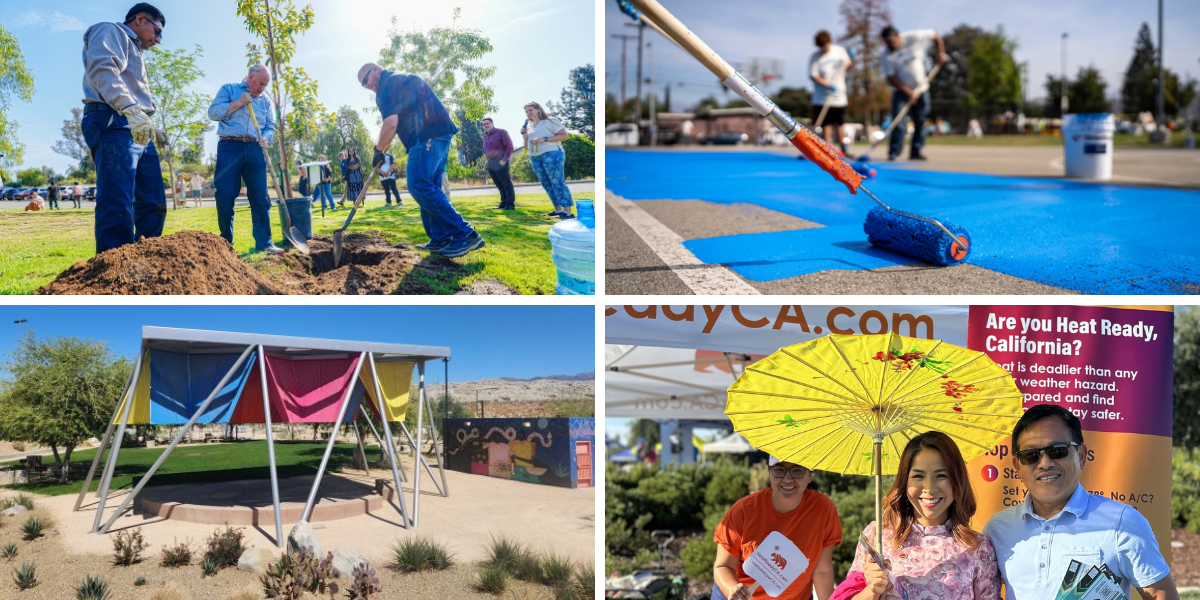
- Increased investments in urban greening, shade, cooling infrastructure, and climate resilient buildings to reduce heat impacts in neighborhoods most vulnerable to extreme temperatures.
- Improved statewide coordination around extreme heat planning, emergency response, worker safety, and public health preparedness through an all-of-government approach.
- Established and expanded the Extreme Heat and Community Resilience Program – one of many state programs focused on building resilience – to support locally driven projects focused on cooling, emergency response, and protecting vulnerable communities. The first round of funding in fiscal year 2024-25 awarded nearly $32 million across 45 projects, and Round 2 is in the works. Learn more about two of the projects – in Lake County and Tulare County.
In California, we've really been trying to change the way that we're thinking about heat. It isn't just a weather issue, it's a public health issue, it's an equity issue, it's a systems challenge, and that's why our Extreme Heat Action Plan is really central to a lot of our work.
As the planet experiences more intense and deadly heat waves year over year, we are committed to building a global movement to address extreme heat.
Ultimately, the question before all of us is not whether the world will be hotter; it is how we choose to prepare, adapt, and build communities where people can live and thrive. California has built partnerships with cities, states, and countries around the world, creating opportunities not only to share what we are learning, but to learn from others who are on the frontlines of climate adaptation. We want to move beyond simply exchanging ideas. We want to build a stronger, shared understanding of what works.