By Nathan Martin, Communications Analyst I
At the California Governor’s Office of Land Use and Climate Innovation, we are proud to join the State of California in recognizing Disability Pride Month. Celebrating Disability Pride is an act of inclusion. It means you are saying people with disabilities belong, contribute, and deserve the same dignity and opportunities as anyone else.
For some, pride is about expressing joy and celebration; for others it is expecting basic dignity, equal access, and fair treatment. Whichever way you frame it, pride is about belonging.
More than 30 years after the passage of the Americans with Disabilities Act of 1990, people with disabilities continue to encounter barriers to full participation in society. Some barriers are physical, such as buildings, transportation systems, or public spaces that are difficult to access. Others are created through policies, workplace practices, technology, communication methods, or social attitudes. Many of these barriers are connected to ableism. Ableism is discrimination or prejudice against people with disabilities. It assumes that non-disabled ways of moving, thinking, communicating, or living are superior. It can also create the harmful belief that disabled people must be “fixed” or that they are defined only by their conditions.
Ableism may be obvious, but it can also surface in subtle ways. It can be found in inaccessible meetings, inflexible procedures, dismissive attitudes, or the assumption that everyone experiences the world in the same way. Ableism shows up in policies, practices, attitudes, and physical spaces that exclude or devalue people.
People with disabilities are part of every segment of society—across ethnicities, religions, nationalities, gender identities, and expressions. This community is not a single demographic and is often overlooked or marginalized. Importantly, not all disabilities are visible. Developmental disabilities like autism can or cannot be masked, and many people with non-apparent disabilities still need accessibility and reasonable accommodation to participate fully in their workplaces and society. A person does not need to “look disabled” to need accessibility or reasonable accommodations.
Disability Pride Month is more than a symbolic observance. It is part of a broader cultural and political movement built on decades of advocacy and resilience. It amplifies disabled voices, challenges outdated perceptions and reframes disability as a vital and visible part of human diversity. The disability community is rich in culture, strength, and diversity, yet it has also endured centuries of exclusion. For much of recorded history, people with disabilities were segregated from public life and denied education and basic rights. Support systems were limited or nonexistent, and institutionalization was often the default response. Despite these conditions, the disability community built networks, supported one another, advocated for change, and created the concepts of disability justice and disability pride.
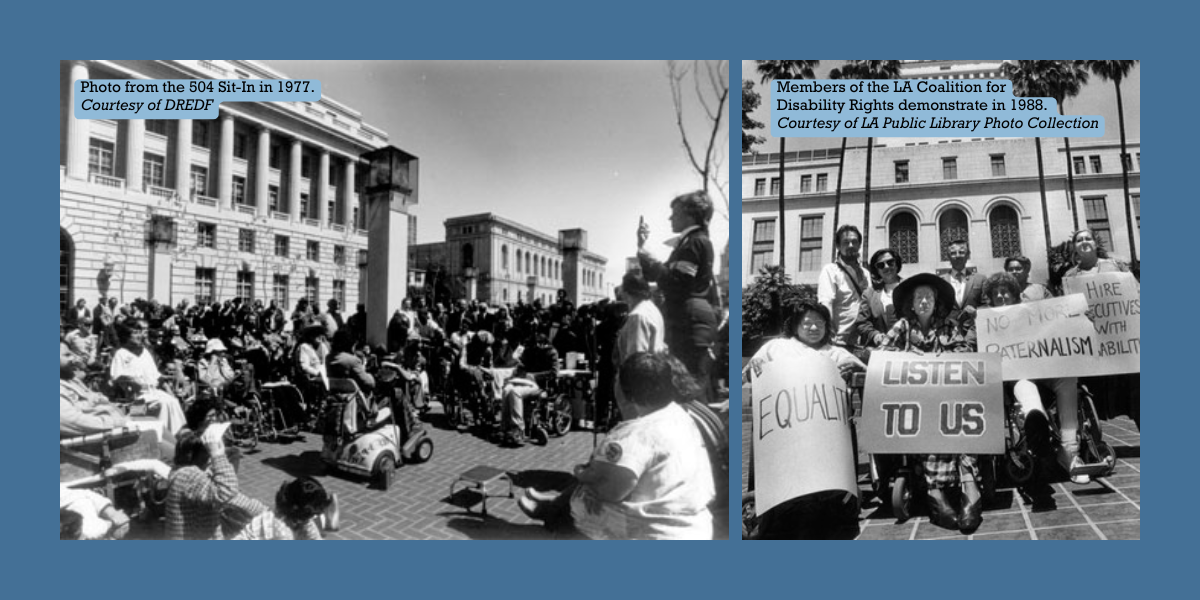
One of the most important events in American disability rights history was the 1977 San Francisco Section 504 Sit-In. Section 504 of the Rehabilitation Act prohibited disability discrimination in programs receiving federal funding; however, the federal government delayed issuing the regulations needed to enforce the law. In response, disabled activists occupied federal buildings across the country. In San Francisco, more than 100 people participated in an occupation that lasted nearly a month. Activists including Judy Heumann, Kitty Cone, and Mary Jane Owen helped lead and organize the demonstration. The San Francisco protest became the longest non-violent occupation of a federal building in United States history. The determination of the activists helped secure implementation of Section 504 and created momentum for broader civil rights protections. Thirteen years later, the Americans with Disabilities Act of 1990 established protections against disability discrimination in employment, public services, public accommodations, transportation, and telecommunications.
Celebrating Disability Pride must involve more than recognition. It must also include practical efforts to expand opportunity, accessibility, and independence. California supports people with disabilities through a range of state, local, nonprofit, and campus-based programs. The Limited Examination and Appointment Program, commonly known as LEAP, provides an alternative pathway for people with disabilities seeking employment in California civil service. Through LEAP, eligible candidates may receive certification from the California Department of Rehabilitation, complete an examination to establish eligibility, apply for open positions, and participate in a Job Examination Period if selected. Programs such as LEAP help remove unnecessary barriers and create more equitable pathways into public service.
California is also home to a statewide network of nonprofit Independent Living Centers. Independent Living Centers are disability-led organizations that help people with disabilities increase autonomy and participate more fully in their communities. Services may include advocacy, peer counseling, information and referrals, independent living skills training, and assistance with moving from institutional settings into community-based living. The California Foundation for Independent Living Centers (CFILC), headquartered in Sacramento, strengthens this network by offering statewide support and managing additional programs, including AbilityTools for assistive technology, Disability Disaster Access and Resources, and the Digital Access Project. CFILC also maintains a directory that helps residents locate their nearest ILC.
In the state’s community colleges, Title 5 § 58108 guarantees the highest and equal priority registration for several student groups, including those served by Disabled Student Programs & Services (DSPS), veterans, active‑duty military, foster and homeless youth, CalWORKs students, and student parents. Individual districts may add local priority tiers to ensure certain student populations can enroll in classes early enough to secure the courses they need. Among the most impactful campus programs is Extended Opportunity Programs & Services (EOPS), which provides comprehensive counseling, financial assistance, and retention support for students facing educational and economic barriers. These programs help students access courses, navigate college systems, and continue progressing toward their goals.
As we reflect on the Independent Living Movement and the broader history of disability rights, the path forward is clear. Progress depends on listening to diverse disabled voices, investing in accommodations and accessibility, and designing programs and environments that welcome everyone from the start.
We invite you to join LCI in celebrating belonging and access—learning how ableism harms, why accommodations matter, and how the Disability Rights Movement and Disability Pride Month continues to shape a more just and inclusive future.