
By Akilah Jones, LCI Communications
Extreme heat is among California’s deadliest climate hazards, and one of its fastest growing.
As climate change fuels hotter days, warmer nights, and longer heat waves, the impacts extend far beyond uncomfortable temperatures. Extreme heat threatens public health, strains infrastructure, disrupts transportation and energy systems, threatens ecosystems, and places increasing pressure on households and communities across the state.
California is responding to extreme heat as the serious threat it is. Through the Governor’s Office of Land Use and Climate Innovation’s (LCI) Extreme Heat and Community Resilience Program (EHCRP), the state is investing in long-term planning, infrastructure, technical assistance, and statewide collaboration to help communities prepare for the impacts of extreme heat.
“Since 2022, California has made significant progress preparing for a hotter future, including more than $31 million invested through the Extreme Heat and Community Resilience Program in 45 projects across 23 counties. But the real measure of that progress is what those investments mean for people—a shaded playground, reliable cooling in a family’s home, or the resources a community needs to prepare before the next heat wave. That’s how we turn statewide climate strategy into resilience people can see and feel in their everyday lives."
That work begins with recognizing a fundamental challenge: Extreme heat affects every region of California, but its impacts are not felt equally.
Heat Is a Statewide Challenge, but Its Impacts Are Unequal
Extreme heat is not just a summer problem anymore. California is experiencing hotter days, warmer nights, and longer periods of extreme heat earlier and later in the year. Beyond increasing the risk of heat-related illness and death, prolonged heat can strain energy systems, damage infrastructure, reduce worker productivity, and increase costs for all entities – families, local governments, businesses, schools, etc.
Those risks are also unevenly distributed. Older adults, children, outdoor workers, people experiencing homelessness, people with disabilities, and residents with limited access to cooling, shade, or green space can face greater risks during extreme heat events.
In many communities, those disparities reflect decades of underinvestment that have left neighborhoods with fewer trees, less shade, and limited access to cooling infrastructure.
Reducing those risks requires more than responding when temperatures reach dangerous levels. It means helping communities prepare long before an emergency arises through sustained planning, strategic investments, community partnerships, and public awareness.
That is where the Extreme Heat and Community Resilience Program (EHCRP) comes in.
From Responding to Heat to Preparing for It
Administered through LCI’s Integrated Climate Adaptation and Resiliency Program (ICARP), the Extreme Heat and Community Resilience Program coordinates California’s statewide efforts to reduce the impacts of extreme heat and the urban heat island effect.
The program helps local governments, tribal governments, regional agencies, and community organizations plan and implement projects that protect residents from extreme heat while strengthening long-term community resilience.
That work goes beyond funding individual projects. EHCRP provides technical assistance, supports peer learning among communities, and helps implement California’s Extreme Heat Action Plan, connecting local solutions with a broader statewide strategy.
A Statewide Roadmap for Extreme Heat
California’s Extreme Heat Action Plan serves as the state’s roadmap for reducing the health, economic, environmental, and social impacts of extreme heat.
The Action Plan focuses on four statewide priorities:
- Building public awareness
- Strengthening community response
- Increasing the resilience of the built environment
- Expanding nature-based solutions
California published the updated the Action Plan in August 2026, building on the state’s first plan released in 2022. The update highlights progress made over the past four years while incorporating public engagement and identifying ongoing opportunities and future opportunities to strengthen California’s resilience to extreme heat.
At the heart of the plan is a shift from simply responding to heat emergencies to preparing communities before they occur. That means investing in infrastructure, public education, planning, and partnerships that can reduce risks before temperatures begin to climb.
Turning Plans into Projects
Statewide strategies ultimately must translate into changes people can see and feel in their own communities.
EHCRP supports capacity building projects designed to reduce heat impacts where they are needed most.
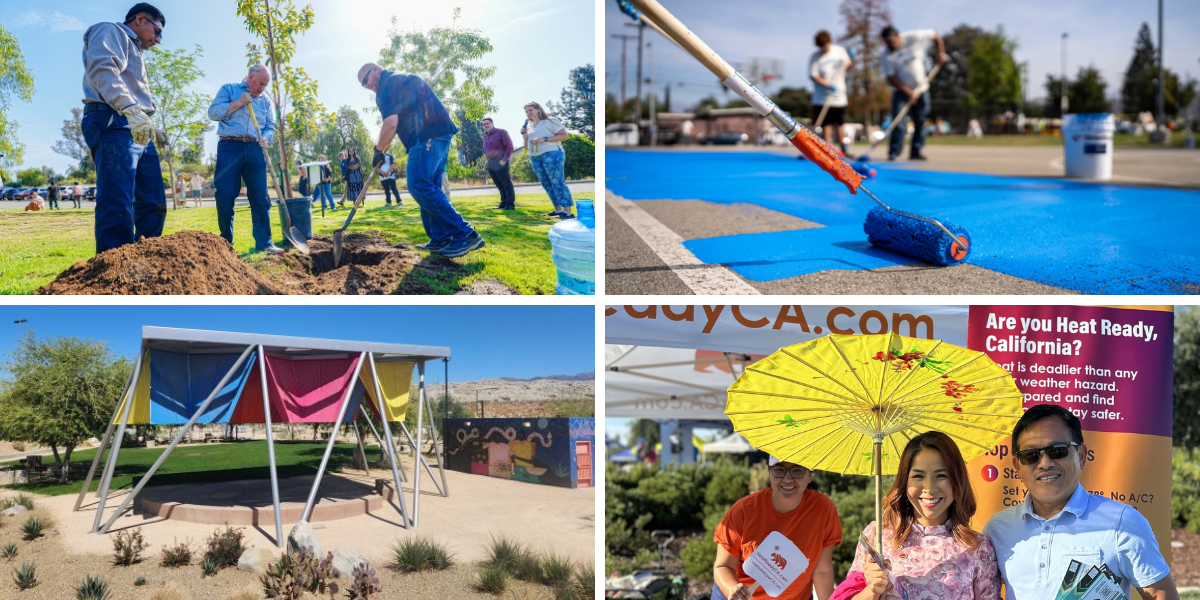
Planning projects can include shade and urban forestry master plans, heat action plans, green stormwater infrastructure plans, and resilient energy and microgrid planning.
Implementation projects turn those plans into physical improvements, including park and public space retrofits, cooling centers, home cooling improvements, shade structures, urban greening, microgrids, surface reflectance improvements, nature-based solutions, and passive or low-energy cooling strategies.
Together, these investments can help lower temperatures, protect public health, and prepare neighborhoods for future climate conditions.
And across California, communities are already putting those investments to work.
From Shade Structures to Home Cooling: Round 1 in Action
Through EHCRP’s first funding round, part of California Climate Investments, California invested $31.2 million in 45 projects spanning 23 counties, supporting both capacity-building and implementation projects that help communities prepare for and respond to extreme heat.
Behind those numbers are projects addressing the specific ways heat affects communities.
In Tulare County, new shade structures have been installed at playgrounds in Alpaugh, Woodville, and Ledbetter parks, helping protect children and families from dangerously high temperatures.
In Lake County, the Middletown Rancheria of Pomo Indians has installed 13 solar-powered HVAC systems in residents’ homes, with an additional 32 systems planned for seniors and residents with chronic health conditions. The permanent installations provide immediate cooling relief while helping reduce long-term energy costs.
Farther south, in Los Angeles County’s Florence-Firestone community, Kounkuey Design Initiative developed modular bus shelter designs that can be installed at approximately 86% of unsheltered bus stops, significantly expanding the number of locations where shade could be provided.
Different communities face different heat challenges, and these projects demonstrate why locally driven solutions matter. A strategy that works at a rural park may look very different from one needed in a tribal community or at an urban bus stop.
Learn more about the success of EHCRP projects on our website.
Centering Equity in Heat Resilience
Designing heat resilience strategies around the specific needs and conditions of each community is also central to EHCRP’s approach to equity. Communities facing the greatest heat risks are often the same communities that have experienced decades of underinvestment. Neighborhoods with fewer trees and less shade, more pavement and structures that absorb heat, limited cooling infrastructure, and greater socioeconomic barriers can face significantly higher risks when temperatures rise.
The same principle guides how EHCRP approaches equity.
EHCRP embeds equity throughout its funding process by prioritizing projects serving heat-vulnerable communities, reducing barriers to accessing funding, providing technical assistance, supporting Tribal governments and community-based organizations, and encouraging locally driven planning that reflects community priorities.
One of the most direct ways the program supports that work is by providing communities with the resources to turn their priorities into projects.
Building on the Momentum: Round 2
EHCRP recently released its Final Round 2 Guidelines, supported by Proposition 4 and California’s Greenhouse Gas Reduction Fund.
Round 2 will fund infrastructure projects that reduce extreme heat impacts while strengthening long-term community resilience.
Eligible applicants include local governments, regional public agencies, California Native American Tribes, community-based organizations, and eligible nonprofit coalitions and academic partnerships.
But access to funding is only part of the equation. Communities also need support navigating the application process and developing competitive proposals. To help, the Round 2 process includes technical assistance, workshops, webinars and office hours for eligible applicants.
$27.5 million in Funding available
As EHCRP expands its investments, that combination of funding and technical support helps more communities move from identifying their heat risks to implementing solutions.
Partnerships Drive Statewide Action
No single program or agency can address extreme heat alone.
EHCRP works alongside state agencies, local and tribal governments, community-based organizations and academic partners implementing California’s broader approach to extreme heat.
Partners include the Office of Environmental Health Hazard Assessment (OEHHA), California Governor’s Office of Emergency Services (Cal OES), California Natural Resources Agency, California Department of Public Health (CDPH), California Department of Insurance (CDI), Listos California, local governments, tribal governments, community-based organizations and academic partners including UCLA.
Together, these partnerships connect research, planning, public education, emergency preparedness, and on-the-ground implementation.
They also help ensure that Californians have access not only to long-term resilience investments, but to information they can use when extreme heat is approaching.
Helping Californians Understand Their Heat Risk
One example is CalHeatScore, a statewide public health tool developed by OEHHA to help Californians understand the health risks posed by heat before dangerous conditions occur.
For every ZIP code in California, CalHeatScore combines weather forecasts with historical health impacts to generate a heat health risk score from 0, or Low, to 4, or Severe.
Instead of simply telling residents how hot it will be, CalHeatScore helps put those temperatures into context by showing when heat is more likely to affect health—particularly for older adults, children, outdoor workers and other populations vulnerable to heat-related illness.
The tool also provides heat safety guidance and helps users locate nearby cooling centers, making it easier to take action before dangerous conditions develop.
LCI supports outreach and communication efforts to help Californians use CalHeatScore alongside local emergency resources.
Need help using CalHeatScore? Watch our video tutorial on YouTube.
Building Resilience Means Investing in People
Infrastructure and planning are critical pieces of climate resilience, but the impact of these investments can reach beyond cooling homes and shading public spaces.
For some Californians, resilience projects can also create pathways to skills, employment, and greater economic stability.
One Round 1 SolarCHILL workforce trainee shared:
“When I applied to the BUILD construction crew, I was stuck without work and with a baby on the way—living in a trailer. I was recently out of prison on probation. Now I have a house. I’m finally in a position to get custody of my kids. I have a lot more connections, job opportunities, and am in the BUILD Solar HVAC program now.”
Stories like this illustrate what community resilience can mean in practice. An investment designed to help a neighborhood withstand extreme heat can also build workforce skills, create economic opportunities, and improve the lives of people who call that community home.
Building a More Heat-Resilient California
California cannot prevent hot weather, but communities can be better prepared for extreme heat.
That preparation begins long before temperatures spike. It happens when a community plants trees that will provide shade for decades. When a family gains access to reliable home cooling. When children can play beneath a shade structure instead of in direct summer sun. When a bus rider has shelter from the heat. When local leaders have the data, plans, and funding they need to protect their residents.
Through the Extreme Heat and Community Resilience Program, California is investing in those solutions today while helping communities prepare for the climate conditions of tomorrow.
Building resilience in a hotter California is not simply about responding to the next heat wave. It is about creating healthier, safer, and more prepared communities for generations to come.
Learn More
- Explore the Extreme Heat and Community Resilience Program
- Read California’s 2026 Extreme Heat Action Plan
- Check your ZIP code’s heat health risk with CalHeatScore
- Sign up for EHCRP updates and future funding announcements